

By: Omer Sidahmed
Since the outbreak of war in Khartoum in April 2023, Uganda has become one of the main destinations for those fleeing the war, with a number of Sudanese refugees having sought refuge there since the events of the “Operation Long Arm“ in 2008. According to the February 2025 update issued by the United Nations High Commissioner for Refugees in Uganda, UNHCR the number of Sudanese refugees in Uganda since the start of the war in Sudan in April 2023 stands at 67,504, of whom 9,505 (14%) live in urban areas, and the rest live in the ”Kiryandongo” Refugee Settlement alongside Congolese, Rwandan, Burundian, Tanzanian, Kenyan, and South Sudanese refugees. The Ugandan government provides each refugee with half an acre of land, as well as farming tools, seeds, and cooking utensils. There is also irregular financial support from the Refugee Commission in the form of food rations and cash transfers. Refugees receive free health care in governmental hospitals and health centers.
Geography of the Kiryandongo settlement: The settlement is located in Kiryandongo District, in the West Central Region, which is crossed by the main road connecting the capital Kampala and South Sudan, at coordinates 32.06° east, and 1.83 north, 220 kilometers from the capital Kampala, a 4-5 hour drive from the capital. Natural and topographical environment: The camp is located on a flat plateau at an altitude of between 1,100 and 1,300 meters above sea level. The climate is humid subtropical, with average rainfall ranging from 1,100 to 1,200 mm per year. There are no permanent rivers in the camp, and people rely on rainfall for agriculture and on groundwater wells for domestic water, most of which are operated by rope and pulley or hand pumps known as (karjaka). The small number of wells contributes to almost constant friction between refugees of different nationalities over the wells and hand pumps, especially in the morning and when the heat is intense.
Despite Uganda’s open policy towards refugees, which allows them freedom of movement, work, education, and property ownership, the large numbers who have arrived in a short period of time have put pressure on services and resources, leading to:
– Shortages of food, drinking water, and water for domestic use due to limited regional and international humanitarian aid funding.
– Deterioration of health services.
– Lack of sustainable employment opportunities.
– Psychological and social problems.
– Deterioration of social relations with host communities, which until recently were refugees’ communities themselves but have become host communities due to their lengthy stay in Uganda, including refugees from South Sudan.
Due to the high organizational capabilities of Sudanese refugees during the five years prior to their arrival, in addition to the fact that many of them had experienced internal displacement in camps in Darfur, South Blue Nile, South Kordofan, and eastern Sudan, Sudanese refugees in Uganda stood out among their fellow refugees of other nationalities who relied on tribal or clan leadership, with self-organization represented by the first groups to arrive at the Kryandongo settlement in the first month. The self-organization of Sudanese refugees in Uganda is based on grassroots representation, which is represented in two bodies, one is in the planning level and the other executive, namely:
1- The leadership office of the Sudanese Refugee Community in Uganda.
2- The Executive Office of the Sudanese Refugee Community in Uganda.
The Sudanese refugees in the settlement have secured the right for each cluster to have a representative who directly represents them before the Office of the Prime Minister (OPM), the Humanitarian Aid Commission, the Red Cross, the World Food Programme, and other relevant organizations and bodies.
Violence in the Kyandongo camp:
Monitoring of events between July 11 and 13, 2025:
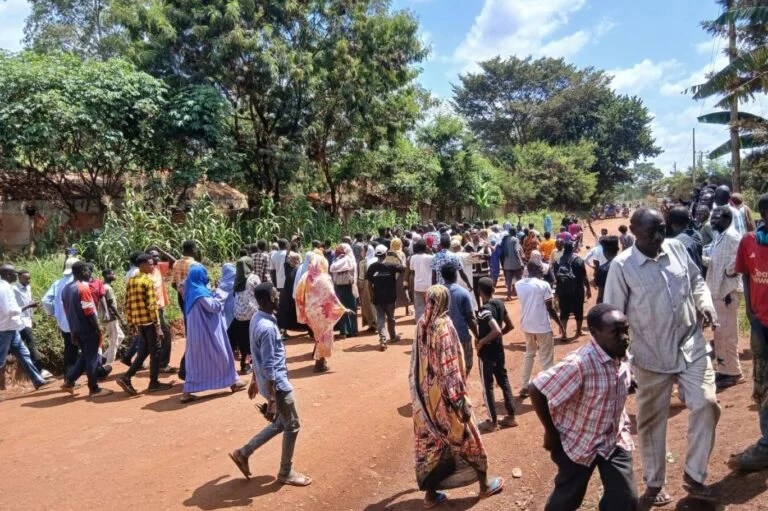
Day 1 (July 11, 2025): Sudden attacks broke out in the evening hours by groups of Nuer inside the camp, using knives and sticks, resulting in serious injuries among Sudanese refugees, including women, children, and the elderly, and killing two. This sparked widespread panic, prompting families to flee their homes and seek shelter in public centers, government buildings, and the buildings of international organizations operating in the settlement. Since that day, Sudanese refugee communities have experienced displacement within the existing refugee situation.
Day 2 (July 12, 2025): The violence spread, and dozens of families were forcibly displaced from their homes in the camp under threat of violence. Humanitarian organizations remained silent until this day.
Day 3 (July 13, 2025): Tensions continued, with a relative decrease in the intensity of attacks after limited intervention by the authorities. However, the humanitarian situation worsened with a severe shortage of health services. On the third day, many families remained displaced or forcibly displaced within the camp, without shelter.
Currently, the prevailing interpretation and analysis of the events of July focuses solely on the encroachment of Sudanese refugees on agricultural land that was cultivated by the Nuer tribe, which has become a host community. In my opinion, the fundamental issue lies in the sudden transfer of an entire community—the Nuer tribe—from a pastoralist to an agricultural production model without adequate rehabilitation to enable them to accept the transition and understand the implications of practicing new livelihoods. This change of the livelihood production model in a sudden manner and without sufficient training to enable them to accept the transition and understand the implications of the new livelihoods was imposed on them by their refugee status. The relationship of herders to the land is that it is the surface on which they and their livestock walk, and they know nothing about the issue of land ownership except of what their elders knew—and adopted in a customary manner—about the Sudanese Hawakeer system (collective tribal ownership of land), which conflicts with the system of the host country responsible for granting land to other refugees.

The organizations formed by Sudanese refugees succeeded
The organizations formed by Sudanese refugees succeeded in a conscious and decisive manner, and had the greatest impact in overcoming the July violence in the Kiryandongo settlement. The Sudanese refugee organizations relied on documenting the damage first, then opening and managing direct discussions involving the South Sudanese refugee community from various tribes, not just the Nuer, in addition to the Office of the Prime Minister (OPM), the governor of Kiryandongo area, the county army commander, the county security director, the county police director, the representative of the Refugee Commission, and representatives of the refugee communities of seven countries in the settlement. The discussions ended with the adoption of a report and recommendations by the leadership and executive offices of the Sudanese refugee community, the most important of which was the formation of a joint committee of refugees of different nationalities to manage any conflicts that may arise in the future. All participants in these discussions praised the ability of Sudanese refugee organizations to bring all these parties together under one roof. The suffering of Sudanese and other refugees and those who have recently transitioned from refugee status to a host community should not be compounded, and refugee communities should be dealt with after a comprehensive and accurate historical and social study.

Leave a comment